
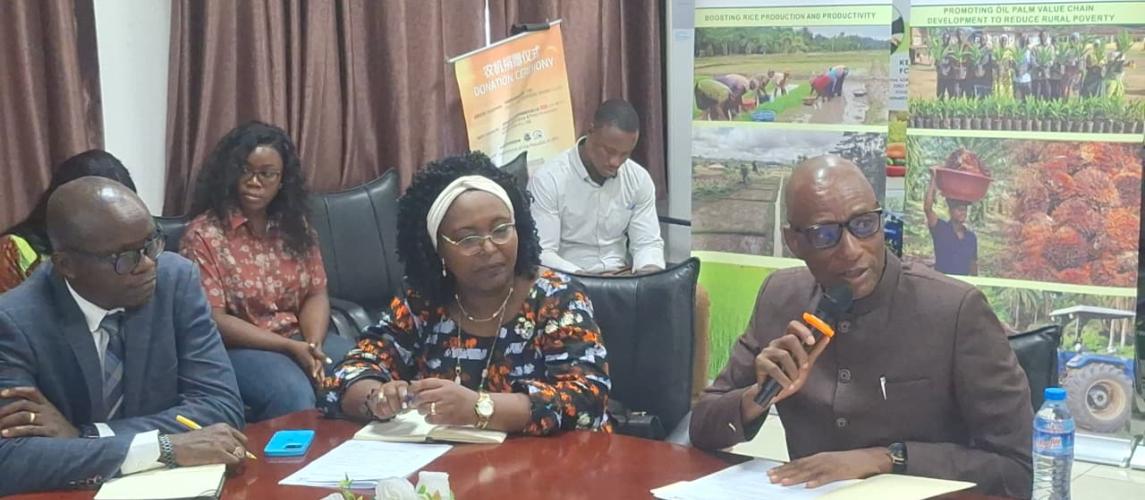
IFAD and Government of Liberia Strengthen Agricultural Transformation Through STAR-P and ILSA Implementation Support Mission
Monrovia, Liberia – April 8, 2026 – The Government of Liberia, through the Ministry of Agriculture, in collaboration with the International Fund for Agricultural Development (IFAD), has launched a ten-day high-level Implementation Support Mission (ISM) for two flagship agricultural programs—the Smallholder Agriculture Transformation and Agribusiness Revitalization Project (STAR-P) and the Investing in Livelihood Resilience and Soil Health in ACP Countries (ILSA) Project.
Launching the Implementation Support Mission (ISM) on behalf of Agriculture Minister Dr. J. Alexander Nuetah, Deputy Minister for Planning and Development, Hon. David K. Akoi, reaffirmed the Government’s strong commitment to transforming Liberia’s agricultural sector and improving rural livelihoods.
“The STAR Project represents a cornerstone of our national strategy to achieve food security, create jobs, and improve rural livelihoods. Through our partnership with IFAD, we are laying a solid foundation for a more productive and resilient agricultural sector,” he said.
The Deputy Minister conveyed the Minister’s appreciation for IFAD’s continued partnership and technical support, emphasizing that the collaboration remains critical to achieving national food security and rural economic recovery.
The STAR-P Project, currently implemented across all fifteen counties, continues to deliver significant results by developing 3,000 hectares of lowland for rice production and rehabilitating approximately 100 kilometers of feeder roads in Nimba, Margibi, and Gbarpolu Counties. The project is strengthening support to smallholder farmers through cluster-based approaches, capacity building, and the transfer of improved agricultural technologies.
Complementing these efforts, the ILSA Project is advancing sustainable agriculture and soil health by developing 40 hectares of cassava, vegetables, maize, and legumes through model farms. It is also empowering 25 agro-enterprises through a matching grant scheme focused on bio-fertilizers, bio-pesticides, and local seed production.
“Our focus is not only on increasing production but also on promoting sustainable practices and strengthening institutions that support agriculture. Through ILSA, we are investing in innovation, soil health, and local enterprise development to ensure long-term impact,” he added.
The Government of Liberia continues to prioritize agricultural transformation as a key driver of food security, economic growth, and rural development.
Over the course of the ten-day mission, a joint team comprising IFAD experts, the Ministry of Agriculture, the Project Implementation Unit (PIU), and key stakeholders—including the Ministries of Finance, Public Works, and Commerce- will conduct field assessments and technical reviews to ensure that project implementation remains aligned with approved work plans and delivers value for money.
The mission will also focus on identifying bottlenecks, strengthening operational efficiency, and ensuring that project benefits reach intended rural communities in a timely and equitable manner.
IFAD Country Director, Ms Pascaline Barankeba, reaffirmed IFAD’s strong partnership with Liberia and commended the Government for its continued commitment to transforming the agriculture sector and improving the livelihoods of smallholder farmers.
“STAR-P and ILSA are instruments of change in Liberia. They are designed to empower smallholder farmers, strengthen agricultural value chains, and build resilience in the face of climate variability and economic challenges,” Ms. Barankeba stated.
She emphasized that the mission represents more than a routine exercise, describing it as a critical opportunity to reflect on progress, assess performance, and strengthen the delivery of results under both projects.
Highlighting tangible impact, Ms. Barankeba cited success stories from Lofa County, where a women’s cooperative significantly increased its cultivated area and income, and where visually impaired farmers trained under STAR-P are now producing enough to sustain their households and sell surplus produce.
“These results demonstrate that with the right investments and partnerships, agriculture can drive inclusive economic growth and improve rural livelihoods,” she noted.
Ms. Barankeba reaffirmed IFAD’s commitment to supporting Liberia not only through financing but also through technical expertise, policy dialogue, and long-term partnership. She also acknowledged the efforts of the PIU and implementing partners, commending their dedication to delivering results under often challenging conditions.
The Government of Liberia and IFAD remain committed to ensuring that STAR-P and ILSA deliver lasting impact—strengthening food security, improving livelihoods, and driving sustainable agricultural growth
